
 Chat with Astrologer






Eclipse 2027 (Grahan 2027)
Eclipse 2027 (Grahan 2027)
Before sharing all the important information about Eclipse 2027 (Grahan 2027), we warmly welcome all our readers to the new year 2027. We hope this year brings happiness, peace, prosperity, and success into your lives.
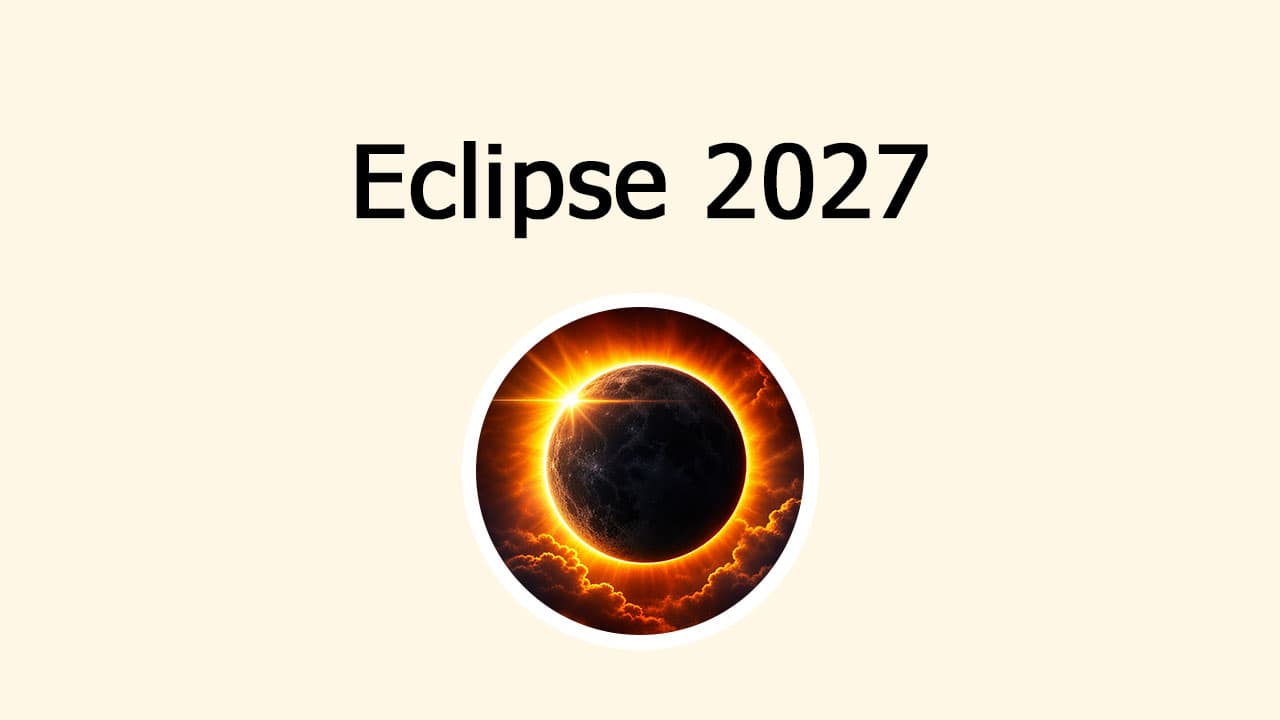
Every new year brings several astronomical events, and solar and lunar eclipses hold special importance among them. Keeping this in mind, AstroSage AI brings you a detailed guide to all the eclipses that will take place in 2027. In this article, you will find all the important information about Solar Eclipse 2027 (Surya Grahan 2027) and Lunar Eclipse 2027 (Chandra Grahan 2027).
To Know About Your Future, Talk To The Best Astrologers
Here, we will tell you when the eclipses will occur in 2027, their starting and ending timings, the countries and regions where they will be visible, and whether they can be seen from India. Along with this, we will also discuss the scientific reasons behind eclipses, their religious and astrological significance, and the importance of Sutak Kaal.
This special article is being prepared based on the study and analysis of AstroSage AI's renowned and experienced astrologer, Dr. Mrigank Sharma. Our aim is to provide you with all the important information about Eclipse 2027 in one place, using simple and easy-to-understand language.
Click Here to Read in Hindi: ग्रहण 2027
However, before discussing the dates and timings of the eclipses, it is important to understand what an eclipse actually is and how a solar eclipse differs from a lunar eclipse.
What Is An Eclipse?
An eclipse is a natural astronomical event that occurs due to the specific positions of the Sun, Earth, and Moon. These three celestial bodies keep moving in their respective orbits. Sometimes, their positions align in such a way that one celestial body blocks the light reaching another for a short period. This event is known as an eclipse.
For example, when the Moon comes between the Sun and the Earth, it blocks sunlight from reaching certain parts of the Earth. This is called a solar eclipse.
On the other hand, when the Earth comes between the Sun and the Moon and its shadow falls on the Moon, it is called a lunar eclipse.
Thus, both solar and lunar eclipses depend on the relative positions of the Sun, Earth, and Moon.
Religious And Spiritual Significance Of Eclipses
In Indian religious and astrological traditions, an eclipse is considered a special period. According to traditional beliefs, chanting mantras, meditation, prayers, and donating to the needy during an eclipse are considered auspicious.
In astrology, eclipses are mainly associated with Rahu and Ketu. It is believed that an eclipse may affect people differently depending on their zodiac signs, birth stars, and planetary positions in their birth charts.
This is why many people wish to know about eclipse timings and the religious remedies that can be followed during and after an eclipse.
Want to see what your Kundli says about the year ahead? Take a look at your Personalized Varshfal for a clear picture.
Which Eclipses Will Occur In 2027?
The year 2027 will be quite important from an astronomical point of view. A total of five eclipses will take place during the year, including two solar eclipses and three lunar eclipses.
The first solar eclipse will occur on February 6, 2027, while the second solar eclipse will take place on August 2, 2027. The lunar eclipses will occur on February 21, July 18, and August 17, 2027.
One important thing to note is that not all these eclipses will be visible from India in the same way. Some will not be visible from India, while others will have very limited or almost unnoticeable visibility.
The most interesting event will be the total solar eclipse on August 2, 2027. It will be visible as a total solar eclipse in some parts of the world, while people in India will be able to see it as a partial solar eclipse.
You may have several questions about these eclipses:
- How many solar and lunar eclipses will occur in 2027?
- What are the dates of the solar and lunar eclipses?
- Will all the eclipses of 2027 be visible in India?
- When will Sutak Kaal begin?
- What should you do and avoid during an eclipse?
Let us find the answers to all these questions in detail.
Solar Eclipse (Surya Grahan)
A solar eclipse is one of the most interesting astronomical events in the universe. It occurs when the Moon comes between the Sun and the Earth. During this event, the Moon blocks sunlight for some time, making the Sun appear partially or completely covered from certain parts of the Earth. This event is known as a solar eclipse.
From a scientific point of view, a solar eclipse can occur only on a New Moon day. However, not every New Moon results in a solar eclipse because the Moon's orbit is slightly tilted compared to the Earth's orbit. A solar eclipse occurs only when the Sun, Moon, and Earth come into a particular alignment.
Main Types Of Solar Eclipse
Solar eclipses are mainly divided into three types:
1. Total Solar Eclipse
A total solar eclipse occurs when the Moon completely covers the Sun. During this event, sunlight is blocked for a short period, and the sky may become dark even during the daytime in areas where the total eclipse is visible. At this time, the Sun's outer atmosphere, known as the corona, may also become visible.
2. Partial Solar Eclipse
A partial solar eclipse occurs when the Moon covers only a part of the Sun. During this event, one part of the Sun appears covered while the remaining part continues to shine.
3. Annular Solar Eclipse
An annular solar eclipse occurs when the Moon comes between the Sun and the Earth but appears smaller than the Sun because of its distance from the Earth. As a result, it cannot cover the Sun completely. Instead, a bright ring-like shape appears around the Moon. This is known as an annular solar eclipse or the Ring of Fire.
According to religious and astrological beliefs, a solar eclipse is associated with Rahu and Ketu. Chanting mantras, meditation, and donating to the needy are considered auspicious during this period.
If you wish to know more about solar eclipses, this article will provide you with all the important information about the dates, timings, visibility, and other details of both solar eclipses taking place in 2027.
Lunar Eclipse (Chandra Grahan)
A lunar eclipse is another important astronomical event, just like a solar eclipse. It occurs when the Earth comes between the Sun and the Moon, causing the Earth's shadow to fall on the Moon. As a result, the entire Moon or a part of it appears dark.
A lunar eclipse can occur only on a Full Moon day. However, not every Full Moon results in a lunar eclipse. For this event to take place, the Sun, Earth, and Moon must come into a specific alignment.
Main Types Of Lunar Eclipse
1. Total Lunar Eclipse
A total lunar eclipse occurs when the Moon completely enters the Earth's dark inner shadow, known as the Umbra. During this event, the Moon may appear red or copper-coloured. This is why it is also called a Blood Moon.
2. Partial Lunar Eclipse
A partial lunar eclipse occurs when only a part of the Moon enters the Earth's dark inner shadow. During this event, one part of the Moon appears normal, while the other part looks dark.
3. Penumbral Lunar Eclipse
A penumbral lunar eclipse occurs when the Moon passes through the Earth's lighter outer shadow, known as the Penumbra. During this event, the Moon's brightness may decrease slightly, but the change is usually difficult to notice with the naked eye.
According to religious and spiritual beliefs, chanting mantras, meditation, and prayers during a lunar eclipse are considered auspicious. In astrology, the Moon is considered the significator of the mind and emotions. Therefore, lunar eclipses are also associated with a person's emotional and mental state.
Now, let us find out when the three lunar eclipses of 2027 will occur and whether they will be visible in India.
AstroSage Brihat Horoscope For All The Valuable Insights Into Future
Sutak Kaal During An Eclipse: Know Its Significance
Whenever we discuss solar or lunar eclipses, Sutak Kaal is another important aspect that comes up. According to Hindu religious traditions, Sutak Kaal is a specific period that begins before an eclipse. During this time, people are advised to avoid certain auspicious and religious activities.
When Does Sutak Kaal Begin?
According to traditional beliefs, the duration of Sutak Kaal is different for solar and lunar eclipses.
Sutak Kaal For Solar Eclipse
Sutak Kaal begins approximately 12 hours before the solar eclipse starts.
Sutak Kaal For Lunar Eclipse
Sutak Kaal begins approximately 9 hours before the lunar eclipse starts.
Sutak Kaal is considered to end with the conclusion of the eclipse. However, according to religious beliefs, Sutak is applicable only in places where the eclipse is actually visible.
Another important point is that traditional Hindu beliefs generally do not consider Sutak Kaal applicable during a penumbral lunar eclipse.
What Should You Do And Avoid During Sutak Kaal?
According to religious beliefs, certain activities should be avoided during Sutak Kaal, while others are considered auspicious.
Things To Avoid During Sutak Kaal
- Avoid performing weddings, housewarming ceremonies, and other auspicious activities.
- Traditionally, cooking and eating food are avoided during this period.
- Temples are generally kept closed.
- Avoid touching the idols of deities.
- Avoid activities such as cutting hair and nails.
Things You Can Do During Sutak Kaal
- Chant mantras and remember God.
- Read religious books and scriptures.
- Take a bath after the eclipse ends.
- Donate food, clothes, and other useful items to people in need.
- Clean your home and place of worship.
These rules related to eclipses and Sutak Kaal are based on religious traditions and beliefs. They should not be considered scientifically proven health guidelines.
Solar Eclipse 2027 (Surya Grahan 2027)
A total of two solar eclipses will occur in 2027. The first solar eclipse will take place on February 6, 2027, Saturday. It will be an annular solar eclipse. The second solar eclipse will occur on August 2, 2027, Monday. It will be a total solar eclipse.
An important thing to note is that the first solar eclipse will not be visible in India, while the second one will be visible as a partial solar eclipse from India.
First Solar Eclipse 2027 – Annular Solar Eclipse
Details | Information |
Date | February 6, 2027 |
Day | Saturday |
Type Of Eclipse | Annular Solar Eclipse |
Maximum Eclipse Time | 9:30 PM (Indian Standard Time) |
Visibility | Parts of South America, particularly Chile and Argentina, the Atlantic Ocean, western and southern parts of Africa, and Antarctica |
Visibility In India | Not visible |
Note: The maximum eclipse time mentioned above is according to Indian Standard Time. The starting and ending timings will differ from country to country.
The first solar eclipse of 2027 will occur on Saturday, February 6. It will be an annular solar eclipse. During this event, the Moon will not cover the Sun completely. Instead, a bright ring will appear around it.
This eclipse will mainly be visible in parts of South America and the Atlantic Ocean. A partial solar eclipse will also be visible in some regions of Africa and Antarctica.
This solar eclipse will not be visible in India. Therefore, according to traditional religious beliefs, Sutak Kaal will not be applicable in India.
Click here to know more about Solar Eclipse 2027.
Second Solar Eclipse 2027 – Total Solar Eclipse
Details | Information |
Date | August 2, 2027 |
Day | Monday |
Type Of Eclipse | Total Solar Eclipse |
Maximum Eclipse Time | 3:37 PM (Indian Standard Time, globally) |
Visibility | Spain, Morocco, Algeria, Tunisia, Libya, Egypt, Saudi Arabia, Yemen, and Somalia |
Visibility In India | Partially visible |
Note: The maximum eclipse time is given in Indian Standard Time according to the global maximum eclipse. The starting and ending timings will differ across Indian cities.
The second solar eclipse of 2027 will occur on Monday, August 2. It will be a total solar eclipse. During this event, the Moon will completely cover the Sun. In areas along the path of totality, the Sun will become completely hidden for a short period.
This eclipse will be visible as a total solar eclipse in parts of Spain, North Africa, and the Arabian Peninsula. A partial solar eclipse will also be visible in several regions of Europe, Africa, and West Asia.
This eclipse will also be important for India, as people here will be able to see it as a partial solar eclipse. However, the portion of the Sun covered by the Moon will differ from one Indian city to another.
Since this eclipse will be visible in India, Sutak Kaal will also be applicable according to traditional religious beliefs.
Click here to know more about Solar Eclipse 2027.
Lunar Eclipse 2027 (Chandra Grahan 2027)
A total of three lunar eclipses will occur in 2027. The first lunar eclipse will take place on February 21, the second on July 18, and the third on August 17, 2027.
The most important thing to note is that all three lunar eclipses in 2027 will be penumbral lunar eclipses. The February eclipse may technically be visible from India in a very faint form, but it will be difficult to identify with the naked eye. The July eclipse will also be extremely faint, while the August eclipse will not be visible in India.
First Lunar Eclipse 2027 – Penumbral Lunar Eclipse
Details | Information |
Date | February 21, 2027 |
Day | Sunday |
Type Of Eclipse | Penumbral Lunar Eclipse |
Eclipse Begins | 2:42 AM |
Maximum Eclipse | 4:43 AM |
Eclipse Ends | 6:43 AM |
Visibility | Asia, Europe, Africa, Australia, North and South America, and Antarctica |
Visibility In India | Technically present, but difficult to notice with the naked eye |
Note: The timings mentioned above are according to Indian Standard Time. The eclipse will begin on February 20 according to Universal Time (UTC), but the date in India will be February 21.
The first lunar eclipse of 2027 will occur on Sunday, February 21. It will be a penumbral lunar eclipse. During this event, the Moon will pass through the Earth's lighter outer shadow, causing a very slight change in its brightness.
This eclipse will be visible in several regions of Asia, Europe, Africa, Australia, and the Americas. The penumbral phase will also be present over India, but it will be so faint that it will be difficult to notice with the naked eye.
According to religious beliefs, a penumbral lunar eclipse is not given the same importance as a regular lunar eclipse. Therefore, traditional Sutak Kaal will not be applicable to this eclipse.
Second Lunar Eclipse 2027 – Penumbral Lunar Eclipse
Details | Information |
Date | July 18, 2027 |
Day | Sunday |
Type Of Eclipse | Penumbral Lunar Eclipse |
Eclipse Begins | 9:27 PM |
Maximum Eclipse | 9:33 PM |
Eclipse Ends | 9:39 PM |
Visibility | A very faint penumbral phase globally |
Visibility In India | Practically invisible |
Note: The timings mentioned above are according to Indian Standard Time.
The second lunar eclipse of 2027 will occur on Sunday, July 18. It will also be a penumbral lunar eclipse. The most interesting thing about this eclipse is that the Earth's lighter shadow will cover only a very small portion of the Moon.
As a result, the change in the Moon's brightness will be extremely slight. According to astronomical calculations, the penumbral intensity of this eclipse will also be very low. Therefore, it will be almost impossible to notice it with the naked eye.
There will be no clearly visible effect of this eclipse in India. Also, according to traditional religious beliefs, Sutak Kaal will not be applicable to this eclipse.
Third Lunar Eclipse 2027 – Penumbral Lunar Eclipse
Details | Information |
Date | August 17, 2027 |
Day | Tuesday |
Type Of Eclipse | Penumbral Lunar Eclipse |
Eclipse Begins | 10:54 AM |
Maximum Eclipse | 12:44 PM |
Eclipse Ends | 2:33 PM |
Visibility | America, parts of Europe, Africa, Australia, some regions of Asia, and the Pacific Ocean |
Visibility In India | Not visible |
Note: The timings mentioned above are according to Indian Standard Time. The eclipse will occur during the daytime in India, which means the Moon will not be visible from here.
The third and final lunar eclipse of 2027 will occur on Tuesday, August 17. It will be a penumbral lunar eclipse. During this event, the Earth's lighter shadow will fall on the Moon, causing a slight decrease in its brightness.
This eclipse will mainly be visible in America, Africa, Australia, and some parts of Europe. However, it will not be visible in India because all its major phases will occur during the daytime here.
Therefore, according to traditional religious beliefs, Sutak Kaal will not be applicable to this eclipse in India.
Free Online Birth Horoscope
Summary Of All Eclipses In 2027
A total of five eclipses will occur in 2027, including two solar eclipses and three lunar eclipses.
No. | Eclipse Date | Type Of Eclipse | Visibility In India |
1 | February 6, 2027 | Annular Solar Eclipse | Not visible |
2 | February 21, 2027 | Penumbral Lunar Eclipse | Very faint; not visible to the naked eye |
3 | July 18, 2027 | Penumbral Lunar Eclipse | Practically invisible |
4 | August 2, 2027 | Total Solar Eclipse | Partially visible |
5 | August 17, 2027 | Penumbral Lunar Eclipse | Not visible |
Thus, the solar eclipse on August 2, 2027, will be clearly visible as a partial solar eclipse in India. The penumbral phase of the February lunar eclipse will also be present over India, but it will be difficult to notice with the naked eye.
To Know The Time Of Raj Yoga, Order Now: Raj Yoga Repor
What To Do And Avoid During An Eclipse – Complete Guide
According to Hindu traditions, certain rules should be followed during an eclipse. These rules are believed to help maintain mental and physical purity and encourage people to focus on prayers and spiritual practices. Let us understand what you should and should not do during an eclipse.
Sutak Kaal And Eclipse Timings
- Solar Eclipse: Sutak Kaal begins approximately 12 hours before the eclipse.
- Lunar Eclipse: Sutak Kaal begins approximately 9 hours before the eclipse.
Remember that these timings are based on traditional religious beliefs. The applicability of Sutak Kaal also depends on the local visibility and type of eclipse.
Eye Safety During An Eclipse
You should take special care of your eyes while watching a solar eclipse.
- Never look directly at the Sun with naked eyes during a solar eclipse.
- Always use special eclipse glasses or certified solar viewers that meet the ISO 12312-2 standard.
- Regular sunglasses are not safe for viewing a solar eclipse.
- Never look at the Sun through a camera, binoculars, or telescope without a proper solar filter.
- Children should also be guided to follow proper safety precautions while watching a solar eclipse.
Things To Avoid During An Eclipse
According to religious beliefs, the following activities should be avoided during an eclipse:
- Avoid performing prayers and auspicious ceremonies during this period.
- Avoid cooking and eating food, according to traditional practices.
- Avoid entering temples or touching idols of deities.
- Avoid cutting your hair and nails.
- Avoid oil massages and other routine activities.
- Traditionally, people are advised not to sleep during an eclipse.
However, taking essential medicines, eating when necessary, and following your daily health requirements are important. You should never avoid these things simply because of religious beliefs.
Get Best Career Counseling With CogniAstro Report
Special Precautions For Pregnant Women
In Indian traditions, pregnant women are advised to take special precautions during an eclipse. According to traditional beliefs, they should avoid certain activities during this period.
However, there is no scientific evidence that an ordinary solar or lunar eclipse can harm an unborn baby.
Therefore, pregnant women should not worry unnecessarily. Avoiding direct exposure to sunlight while viewing a solar eclipse is important for everyone.
Things You Should Do During An Eclipse
According to religious beliefs, the following activities are considered auspicious during an eclipse:
- Chant religious mantras.
- Practise meditation and prayer.
- Read religious books and scriptures.
- Donate to people in need according to your ability.
- Take a bath after the eclipse ends.
- Clean your home and place of worship.
Special Remedies To Reduce The Negative Effects Of An Eclipse
According to astrological beliefs, certain remedies can be performed to reduce the possible negative effects of an eclipse.
- Chant mantras dedicated to the Sun God during a solar eclipse.
- Worship Lord Shiva and Chandra Dev during a lunar eclipse.
- Chant mantras associated with the ruling planet of your zodiac sign.
- Donate food grains, clothes, and other useful items to people in need.
- Take a bath and perform prayers after the eclipse ends.
- Help people in need according to your ability and faith.
All these remedies are based on religious and astrological beliefs.
A Special Message For You Regarding Eclipse 2027
An eclipse is an amazing astronomical event that is understood in different ways through science, astrology, and religious traditions.
The two solar eclipses and three lunar eclipses taking place in 2027 will give you an opportunity to understand these astronomical events more closely. Through this article, we have tried to share all the important information about the dates, timings, visibility, Sutak Kaal, and religious beliefs associated with these eclipses.
We hope this article proves useful to you and helps you get all the necessary information about the eclipses taking place in 2027.
For all kinds of astrological solutions, visit the AstroSage Online Shopping Store.
For Astrological Remedies & Services, Visit: AstroSage Online Shopping Store!
We hope you liked our blog. Thank you for becoming an important part of the AstroSage family. For more interesting blogs, stay connected with us!
Frequently Asked Questions (FAQs)
1. How many solar eclipses will occur in 2027?
A total of two solar eclipses will occur in 2027. The first will take place on February 6, and the second will occur on August 2.
2. How many lunar eclipses will occur in 2027?
A total of three lunar eclipses will occur in 2027. They will take place on February 21, July 18, and August 17.
3. How many eclipses will be visible in India in 2027?
The solar eclipse on August 2, 2027, will be partially visible in India. The penumbral phase of the February lunar eclipse will also technically occur over India, but it will not be visible to the naked eye.
4. Will Sutak Kaal be applicable to all the eclipses in 2027?
No. According to traditional religious beliefs, Sutak Kaal will be applicable to the partial solar eclipse on August 2, 2027, in India. Sutak Kaal is generally not considered applicable to penumbral lunar eclipses.


Astrological services for accurate answers and better feature
Dhruv Astro Software - 1 Year
'Dhruv Astro Software' brings you the most advanced astrology software features, delivered from Cloud.






Astrological remedies to get rid of your problems
Red Coral / Moonga
(3 Carat)

Ward off evil spirits and strengthen Mars.






 Buy Now










 Talk to
 Chat with


