
 Chat with Astrologer









Eclipse 2026
Eclipse 2026: To provide more detailed information about Eclipse 2026 and before presenting an extensive and comprehensive overview of the eclipses occurring in the year 2026, we warmly welcome all the esteemed readers of AstroSage AI and extend heartfelt wishes for the New Year 2026. Every new year brings with it numerous celestial events, and among them, eclipses hold a special significance. Keeping this importance in mind, we have brought together all the essential, in-depth, and profound information related to every eclipse occurring in 2026, whether it is Solar Eclipse 2026 or Lunar Eclipse 2026, in one place for you.
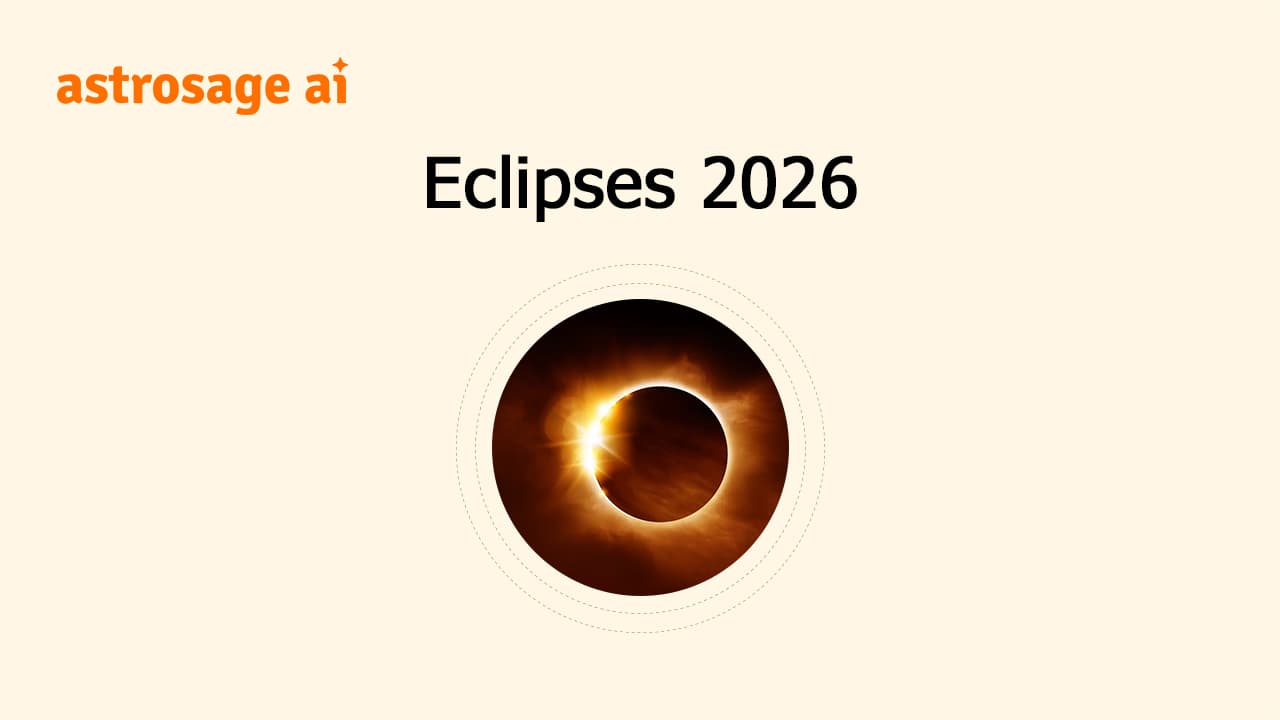
In this article, you will learn when the eclipses will occur in the year 2026, their scientific and astrological significance, the countries or regions where they will be visible, and their possible impact on various zodiac signs, areas of life, and natural conditions.
This detailed article has been prepared on the basis of deep research and analysis by AstroSage AI’s renowned and experienced astrologer, Dr. Mrigank Sharma . We firmly believe that this article will not only provide you with accurate and useful information regarding the eclipses of 2026 but will also help you understand these celestial events and bring meaningful changes to your life according to them.
To Know More About This week, Talk To The Best Astrologers !
We hope that the information shared here will enrich your knowledge and guide you in making the upcoming year more organized, positive, and successful.
Before we dive deeper into this subject, the most fundamental and essential question is: What exactly is an eclipse? Until we understand the scientific structure of this natural phenomenon, the process of knowing its effects, significance, and spiritual aspects will remain incomplete.
From a scientific perspective, an eclipse is an extremely important and fascinating celestial event that occurs due to the specific positions and continuous movements of the Sun, Earth, and Moon. The Sun is the primary source of energy and light for our planet. Earth receives sunlight, and the light reflected from the Sun illuminates the Moon. However, at times, the positions of these three celestial bodies align in such a way that they come into a straight line, and one body blocks the light of another for a brief period.
For example, during a solar eclipse, the Moon comes between the Earth and the Sun, preventing sunlight from reaching certain parts of the Earth. Similarly, during a lunar eclipse, the Earth comes between the Sun and the Moon, blocking sunlight from falling on the Moon. In these extraordinary moments, a portion of the Earth or the Moon temporarily becomes darkened or dimly lit. This condition is scientifically termed an eclipse.
From a spiritual perspective, an eclipse is considered a moment in the universe when energy cycles, natural forces, and subtle vibrations undergo transformation. In many traditions, it is viewed as a special time for introspection, meditation, and mental purification.
On the other hand, according to astrology, eclipses can subtly influence our emotions, thoughts, decisions, and various aspects of life. This is why reputable platforms like AstroSage AI present all eclipse-related information, from scientific facts to spiritual viewpoints, in one place, so that readers not only gain knowledge but also use it positively in their lives.
In my summary, an eclipse is not merely an astronomical phenomenon, but a convergence of knowledge, science, and self-realization. Understanding which can help every individual make their life more aware, balanced, and elevated.
Now that we have understood the basic concept of an eclipse, let us continue this journey of knowledge and explore in detail when the eclipses will occur in the year 2026. From the perspective of celestial events, the year 2026 will be extremely significant, as it will witness multiple eclipses that will not only be fascinating for scientific researchers, but also deeply informative and enriching for astrology enthusiasts, spiritual practitioners, and curious readers in general.
In this article, we will present in a very systematic and simple manner the exact dates, days, timings, and duration for both solar and lunar eclipses. You will also learn in detail from which countries, regions, or cities Eclipse 2026 will be visible, and where it will not be visible at all.
From a scientific viewpoint, eclipses occur as a result of specific positional alignments between the Earth–Moon–Sun system, and therefore, their accurate prediction is based on precise astronomical calculations. In this article, you will not only know the timings and locations of the eclipses, but also understand how astronomy determines them and what the real significance of those calculations is.
Additionally, in Indian tradition, an eclipse is not considered just an astronomical event, but a special opportunity for energy transformation, mental purification, spiritual awakening, and deep meditation. Therefore, in this article, we will also explain in detail the astrological and religious significance of eclipses. We will talk about the eclipses which bring auspicious results, zodiac signs that are more influenced by them, and how eclipses can affect the flow of life energy and mental vibrations.
If your birth chart or zodiac sign is affected by Grahan Dosha and you are concerned about it, this article will prove extremely helpful for you. Here, we will guide you on how to avoid the negative effects of Grahan Dosh, how to reduce or remove its harmful impact, and which special and effective remedies can help you achieve great success, prosperity, good fortune, mental peace, and positive energy in life.
The goal of AstroSage AI is not just to provide information, but to make you aware, empowered, and spiritually enriched. Therefore, this article will not only give you detailed knowledge about the eclipses of 2026 but also guide you toward gaining balance, positive energy, and success in your life.
To Know The Time Of Raj Yoga, Order Now: Raj Yoga Report
Which Eclipse Will Occur In 2026?
The year 2026 is going to be extremely significant in terms of astronomical events, as the sky will witness several rare alignments that will allow us to experience unique phases of the Sun and the Moon.
In total, there will be two solar eclipses and two lunar eclipses in 2026. Some of these eclipses will not be visible from India, while others will be. One important point to note is that the Sutak Kaal is observed only in regions where the eclipse is actually visible in the sky. Therefore, out of all the eclipses in 2026, only one lunar eclipse will be clearly visible from India. Thus, only that particular lunar eclipse will have a valid Sutak Kaal in India, while the remaining eclipses will not, since they will not be visible from our country.
Naturally, a few questions may arise in your mind:
When we are discussing Eclipse 2026, what exactly are solar and lunar eclipses?
Why is Sutak Kaal considered so important in religious and astrological traditions?
On which dates, days, and times will the solar and lunar eclipses occur in 2026?
How long will they last, and in which countries or regions will they be visible?
Understanding the vastness of the universe and the complexity of celestial events is always fascinating. So, let us move forward and present a detailed scientific analysis of these eclipses, along with their astrological meanings, religious importance, visibility details, and Sutak Kaal information.
The purpose of this special article from AstroSage AI is not merely to present facts, but to help you understand the mysteries of the universe so that you may move towards a life that is more aware, balanced, energetic, and successful. So, come with us as we enter the world of detailed information about all the solar and lunar eclipses of 2026, and discover what new mysteries, opportunities, and lessons this celestial year is about to bring for you.
Solar Eclipse
A solar eclipse is one of those fascinating cosmic events that has filled humans with wonder and curiosity for centuries. It is not merely an astronomical sight, but the result of a very precise and scientific alignment between the Sun, Earth, and the Moon. When the Earth is revolving around the Sun in its fixed orbit, and at the same time the Moon is revolving around Earth and reaches a particular point, a unique moment is formed—where the Moon comes exactly between the Earth and the Sun. This is when the Sun’s rays are blocked by the Moon and are unable to reach a certain part of Earth, creating a brief period of darkness or dim light in that region. This remarkable phenomenon is known as a Solar Eclipse.
From a scientific viewpoint, a solar eclipse occurs only when the Moon is in its New Moon (Amavasya) phase and aligns perfectly in a straight line with the Earth and the Sun. This alignment has to be extremely precise. Any slight deviation and the eclipse will not be visible. It stands as a living example of the incredible precision of nature’s calculations and cosmic laws.
Also Read: Today Lucky Colour !
Types Of Solar Eclipse
A solar eclipse may appear in different forms, depending on the distance between the Moon and the Sun and their relative positions.
1. Total Solar Eclipse
When the Moon completely covers the Sun, the Sun’s light cannot reach Earth at all. For a short time, even during noon, the surroundings appear dark like night. This sight is extremely rare and breathtaking. During totality, the solar corona becomes visible, providing scientists with a remarkable opportunity for research.
2. Partial Solar Eclipse
Sometimes the Moon does not cover the Sun completely and only a portion of the Sun is obscured. In such a case, sunlight partially reaches Earth, creating a slight dimness or reduction in brightness. Most people commonly witness this type of eclipse.
3. Annular Solar Eclipse
Occasionally, the Moon does come between the Earth and the Sun, but at that time it is slightly farther from Earth. Due to the increased distance, the Moon appears slightly smaller than the Sun. It covers only the central part of the Sun, leaving the glowing outer edges visible in the form of a bright ring, known as the “Ring of Fire.” This beautiful and striking sight is called an Annular Solar Eclipse.
Lunar Eclipse
A lunar eclipse, much like a solar eclipse, is one of the most extraordinary astronomical events in the cosmos, driven by extremely precise scientific calculations and the perfectly coordinated motion of celestial bodies. Just as during a solar eclipse, the Moon positions itself between the Earth and the Sun, similarly, when the Earth comes precisely between the Sun and the Moon and obstructs the Sun’s light from reaching the Moon, the mesmerizing and mysterious visual that emerges is called a Lunar Eclipse.
How Does A Lunar Eclipse Occur Scientifically?
A lunar eclipse takes place when the Moon, while revolving in its orbit, moves behind the Earth and enters the Earth’s shadow. As soon as the Earth’s shadow falls upon the Moon, the Moon is deprived of direct sunlight. This exact moment is scientifically known as a Lunar Eclipse. This phenomenon is possible only during a Full Moon, as the Sun and the Moon are positioned on two opposite sides of the Earth in a perfectly straight line.
Major Types of Lunar Eclipses
A lunar eclipse appears in several different forms, each having its own scientific and astrological significance:
1. Total Lunar Eclipse
When the Moon completely enters the Earth’s darkest central shadow (Umbra), sunlight is entirely blocked. At this time, the Moon appears in a striking reddish hue, commonly known as a Blood Moon. This visual is deeply captivating for both scientists and spiritual seekers.
2. Partial Lunar Eclipse
When only a portion of the Moon enters the Earth’s umbra and the remaining part stays illuminated, it is known as a partial lunar eclipse. In this phase, the Moon seems partially cut off or dimmed.
3. Penumbral Lunar Eclipse
Sometimes, the Moon doesn’t enter the Earth’s main shadow but only passes through its penumbra (lighter shadow). In this case, no clear dark portion appears on the Moon. Instead, its brightness turns slightly dull or blurred. That is why traditionally it is not widely considered a full eclipse, but scientifically it is still a very interesting phenomenon.
From a spiritual and religious perspective, in Indian traditions, a lunar eclipse is considered a period of energy transformation, mental purification, and spiritual practice. It is believed that during this time, subtle energies in the environment become highly active, making meditation, chanting, prayers, and spiritual disciplines many times more effective. This moment is seen as favorable for self-reflection, releasing negativity, and embracing new positive energy.
If you are curious about astronomy, astrology, spirituality, or the mysteries of the universe, a lunar eclipse offers a golden opportunity for knowledge and insight. AstroSage AI provides complete and detailed information on the dates, timings, visibility regions, scientific reasons, religious significance, astrological effects, and effective remedies related to the Lunar Eclipses of 2026 in one comprehensive article.
To Know Your Moon Sign, click here: Moon Sign Calculator !
Sutak Period of an Eclipse: Scientific, Spiritual & Practical Importance
Whenever we talk about a solar or lunar eclipse, one term naturally comes to mind: Sutak Kaal. Sutak is not just a ritual or tradition, but a significant period recognized in ancient Indian knowledge systems, astrology, and spiritual practices. It refers to a specific duration during which subtle cosmic energy vibrations undergo notable changes, and these changes are believed to influence human mental, physical, and spiritual states.
Scientific & Traditional Foundation of Sutak
Although Sutak is traditionally connected to religious beliefs, it also has a profound scientific and psychological basis. During an eclipse, the light of the Sun or Moon is partially or fully obstructed, due to which subtle changes in radiation, temperature, and energy levels can be recorded in the environment. This is why, since ancient times, precautionary practices have been followed during this period.
When Does Sutak Begin?
The duration of Sutak is different for solar and lunar eclipses:
Sutak period for Solar Eclipse
Sutak begins approximately 4 Prahars before the solar eclipse, which means about 12 hours prior. During this time, the natural energy field is believed to become sensitive, and certain restrictions are observed.
Sutak period for Lunar Eclipse
Sutak begins approximately 3 Prahars before the lunar eclipse, which means about 9 hours prior.
The Sutak period ends immediately once the eclipse ends.
What to Do & What Not to Do During Sutak
According to traditional beliefs, Sutak is considered an inauspicious or sensitive period. Hence, certain guidelines are recommended:
Activities Prohibited During Sutak
Any auspicious or celebratory events
Marriage ceremonies, housewarming, or beginning new ventures
Cooking food or unnecessary travel
Pregnant women are advised to be especially cautious, as actions taken during this time may not yield positive results, and desired outcomes may be hindered.
Activities Recommended During Sutak
Bathing before the eclipse begins
Engaging in meditation, chanting, recitation of scriptures, havan, or mantra sadhana during the eclipse
Taking a bath again after the eclipse ends for the purification of body and mind
Donating essentials and performing charity, which is believed to be highly meritorious
It is mentioned in spiritual scriptures that mantra chanting and spiritual practices performed during an eclipse become many times more effective than on regular days, because subtle cosmic energies are highly active during that time.
When is Sutak Considered Fully Concluded?
It is especially important to remember that Sutak is considered to end only after the eclipse has completely finished and the person has taken a bath to achieve full purification. Only after bathing, meditating, and performing charity or virtuous acts is the Sutak period regarded as concluded.
Now, let us explain in detail which eclipses will occur in the year 2026, when the solar eclipses will take place, and when the lunar eclipses will occur.
Solar Eclipse 2026
If we talk about the Solar Eclipses of 2026, there will be two solar eclipses this year. The first solar eclipse will occur on 17 February 2026, and the second will take place on 12 August 2026. Neither of these solar eclipses will be visible in India.
Now, let us understand the details of both:
First Solar Eclipse 2026: Annular Solar Eclipse
|
Lunar Month & Tithi |
Day & Date |
Solar Eclipse Start Time |
Solar Eclipse End Time |
Visible Regions |
|---|---|---|---|---|
|
Phalguna Month, Krishna Paksha, Amavasya |
Tuesday, 17 February 2026 |
From 3:26 PM |
Until 7:57 PM |
South Africa, Botswana, Zambia, Zimbabwe, Mozambique, southern African countries, Namibia, Mauritius, Tanzania, southern South American countries such as Chile and Argentina, and Antarctica (not visible in India) |
Note: The eclipse timings mentioned in the above table for Eclipse 2026 are according to Indian Standard Time. Since this Solar Eclipse will not be visible in India, it will have no religious or astrological impact in the country, and the Sutak period will also not be applicable.
The first Solar Eclipse of the year 2026 will occur on Tuesday, 17 February 2026. It will be an Annular Solar Eclipse. This Eclipse 2026 will take place in the Aquarius zodiac sign and under the Dhanishta Nakshatra.
Click here to read in detail about Solar Eclipse 2026 (LINK).
Second Solar Eclipse 2026: Total Solar Eclipse
|
Lunar Month & Tithi |
Day & Date |
Solar Eclipse Start Time |
Solar Eclipse End Time |
Visible Regions |
|---|---|---|---|---|
|
Shravan Month, Krishna Paksha, Amavasya |
Wednesday, 12 August 2026 |
From 21:04 (Night) |
Till 4:25 (After Midnight) |
Most European countries, the Northeastern region of Canada, the Northeastern region of Russia, Northwestern African countries. It will be visible in total form in Greenland, Iceland, the Arctic, Northern Spain, the Atlantic Ocean, and the northeastern region of Portugal. It will be visible as partial in France, Britain, most European countries, and Italy. (Not visible in India) |
Note: The timing of the eclipse 2026 given in the above table is according to Indian Standard Time. This solar eclipse will not be visible in India, therefore it will have no religious significance in India and the Sutak period will also not be effective.
The second solar eclipse of the year 2026 will be an annular solar eclipse, which will occur on Wednesday, 12 August 2026. This solar eclipse will take place in the Cancer zodiac sign and Ashlesha Nakshatra.
Free Online Birth Horoscope
Lunar Eclipse 2026
If we talk about the Lunar Eclipses occurring in the year 2026, there will be only two lunar eclipses this year. The first lunar eclipse will occur on 3 March 2026 and the second lunar eclipse will occur on 28 August 2026. Out of these, only the first lunar eclipse will be visible in India.
First Lunar Eclipse 2026: Total Lunar Eclipse
|
Lunar Month & Tithi |
Day & Date |
Solar Eclipse Start Time |
Solar Eclipse End Time |
Visible Regions |
|---|---|---|---|---|
|
Falgun Month, Shukla Paksha, Purnima |
Tuesday, 3 March 2026 |
From 3:20 PM |
Till 6:47 PM |
Pakistan, Afghanistan, Iraq, Iran and most of Western Asia; almost all of Asia; New Zealand, Australia, Antarctica, South & North America, and Russia |
Note: The eclipse timings given in the above table for Eclipse 2026 are according to Indian Standard Time. This lunar eclipse will be visible in India, therefore it will have religious significance in India, and the Sutak period will also be effective. This is the only eclipse of the year that will be visible in India.
The lunar eclipse occurring on 3 March 2026 is a Total Lunar Eclipse, also called a Khagras Chandra Grahan. This total lunar eclipse will take place in the Leo zodiac sign and the Purva Phalguni Nakshatra. The Sutak period for this eclipse will begin on 3 March 2026 at 6:20 AM and will end with the conclusion of the eclipse.
Learn more in detail about Lunar Eclipse 2026 (LINK).
Second Lunar Eclipse 2026: Partial Lunar Eclipse
|
Lunar Month & Tithi |
Day & Date |
Solar Eclipse Start Time |
Solar Eclipse End Time |
Visible Regions |
|---|---|---|---|---|
|
Falgun Month, Shukla Paksha, Purnima |
Friday, 28 August 2026 |
From 8:04 PM |
Till 11:22 PM |
Most regions of Africa, North & South America, Europe, South-West Asia; Afghanistan, Pakistan, Iraq, Iran, Saudi Arabia, Sharjah, and the Indian-Pacific Ocean region. (Not visible in India) |
Note: The eclipse timings given in the above table are according to Indian Standard Time. This lunar eclipse will not be visible in India. Therefore, no Sutak period or religious impact will be considered. This eclipse will occur in Aquarius and under the Shatabhisha Nakshatra.
This partial lunar eclipse will occur on Friday, 28 August 2026, on the Full Moon day (Purnima) of Shukla Paksha in the month of Shravana. Since this eclipse is not visible in India, no Sutak period will be observed, and there will be no religious significance attached to it. Therefore, all tasks and activities may be carried out without any restrictions during this eclipse.
In conclusion, a total of four major eclipses will occur in the year 2026, two solar eclipses and two lunar eclipses. Among these, only the total lunar eclipse of 3 March 2026 will be visible in India.
Get Best Career Counseling With CogniAstro Professional Report
What to Do and What Not to Do During an Eclipse: Complete Guidance for Eclipse 2026
An eclipse is not merely an astronomical event; it is a special period that influences nature and human life. During this time, the subtle vibrations and energies in our environment undergo significant changes. Therefore, in ancient Indian tradition, the eclipse period has been considered a time for special caution and powerful spiritual practices.
Let us understand in detail what should be done and what must be avoided during an eclipse.
Sutak and Eclipse Timing
Solar Eclipse: Approximately 12 hours before
Lunar Eclipse: Approximately 9 hours before
As soon as the eclipse begins (first contact), it is considered extremely important to take a bath. Similarly, at the time of the eclipse ending (moksha), one must again take a bath, as it is believed to be the main process of purification.
Eye and Vision Safety During an Eclipse
During a solar eclipse, never look at the sun with the naked eye, otherwise it can cause severe and permanent damage to eyesight.
Children, elderly individuals, and sick persons must remain particularly cautious during this time.
What is Prohibited During The Eclipse?
Entering temples or touching idols.
Eating food, especially cooked or heavy meals.
Sexual activities or physical intimacy.
Oil massage.
Cutting hair or nails.
Traveling, unless absolutely necessary.
Only in extreme need, children, elderly, and patients may consume light food or necessary medicine.
Special Precautions for Pregnant Women
Avoid cutting, stitching, knitting, or sleeping during the eclipse.
Apply a thin layer of cow dung paste on the stomach.
Cover your head with a dupatta/pallu and apply a little geru.
Things Recommended to Do During an Eclipse
Chanting mantras and meditation.
Charity and donations.
Performing Shraddha or Yajna.
Siddhi of any mantra or spiritual practice, it is believed that mantra chanting during an eclipse becomes a thousand times more powerful.
If someone in the family is seriously ill, continuous chanting of the Mahamrityunjaya Mantra, along with charity and sankalp is beneficial.
Worried About Your Career, Order CogniAstro Report Now!
Special Remedies to Avoid the Negative Effects of Eclipse 2026
Take a bath immediately after the eclipse ends, regardless of whether it is day or night.
During the eclipse period, take a vow (sankalp) and donate to a Brahmin or a needy person
If the eclipse affects your zodiac sign or Nakshatra, chant the mantra of the ruling planet of your sign or Nakshatra.
During a solar eclipse, chant the mantras of the Sun and Rahu, and during a lunar eclipse, chant the mantras of the Moon and Rahu.
Donation according to one’s zodiac sign is considered highly beneficial.
Looking at your reflection in a bronze bowl filled with ghee, with a copper coin placed inside, and then donating it is believed to bring positive results.
After the eclipse, taking an herbal or medicated bath also helps reduce the inauspicious effects.
A Special Message for You Regarding Eclipse 2026
An eclipse is not merely a play of darkness and light. It is a mysterious cosmic phenomenon that influences our lives and mental energies. It is essential to follow the remedies and precautions mentioned above if you wish to protect yourself and your family from the negative effects of Eclipse 2026 and bring health, prosperity, and harmony.
The period of an eclipse is not only meant for protection but is also one of the most powerful opportunities for spiritual practices, mantra siddhis, and earning divine merit (punya).
For Astrological Remedies Services, Visit: AstroSage Online Shopping Store !
We hope you liked our blog. Thank you for becoming an important part of the AstroSage family. For more interesting blogs, stay connected with us!
Frequently Asked Questions
1. How many solar eclipses will occur in the year 2026?
According to Eclipse 2026, a total of 2 solar eclipses will occur in the year 2026.
2. How many lunar eclipses will occur in the year 2026?
According to Eclipse 2026, a total of 2 lunar eclipses will occur in the year 2026.
3. How many eclipses will be visible in India in 2026?
In the new year, i.e., 2026, only one eclipse will be visible in India.


Astrological services for accurate answers and better feature
Dhruv Astro Software - 1 Year
'Dhruv Astro Software' brings you the most advanced astrology software features, delivered from Cloud.






Astrological remedies to get rid of your problems
Red Coral / Moonga
(3 Carat)

Ward off evil spirits and strengthen Mars.






 Buy Now

AstroSage on MobileAll Mobile Apps
- Horoscope 2026
- राशिफल 2026
- Calendar 2026
- Holidays 2026
- Shubh Muhurat 2026
- Saturn Transit 2026
- Ketu Transit 2026
- Jupiter Transit In Cancer
- Education Horoscope 2026
- Rahu Transit 2026
- ராசி பலன் 2026
- राशि भविष्य 2026
- રાશિફળ 2026
- রাশিফল 2026 (Rashifol 2026)
- ರಾಶಿಭವಿಷ್ಯ 2026
- రాశిఫలాలు 2026
- രാശിഫലം 2026
- Astrology 2026
Buy Gemstones

Buy Yantras

Buy Feng Shui

Buy Rudraksh





 Talk to
  Chat with


